Architecture & AI Research Models
Models for trustworthy autonomy and continual learning
AEG and SHIELD explore two architecture boundaries for autonomous systems. PallattuLM is a separate experimental language-model research track exploring whether useful learning can continue without repeatedly updating the entire neural network.
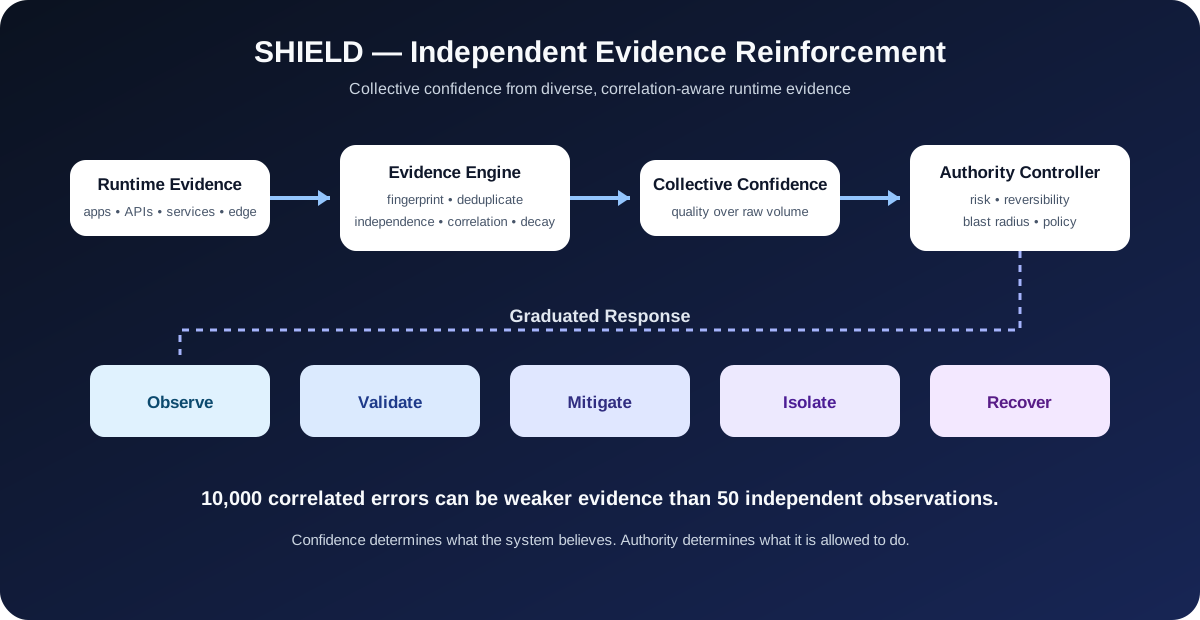
Observation → beliefSHIELDIndependent evidence builds defensible confidence.
+
Intent → executionAEGIndependent governance determines execution authority.
Relationship
Independent research tracks
AEG can govern actions without SHIELD. SHIELD can establish confidence without AEG. PallattuLM addresses a different question entirely: how a language system might acquire, retain, consolidate, and selectively encode new knowledge after deployment. Each track has its own claims, evidence, and limitations.
Choose where to start
What are you trying to understand?
Each model has its own scope, evidence, versions, and adoption path.
AEGCanonical specification · v1.1
What should the system be allowed to do?
The Agentic–Event–Governed Architecture Model separates autonomous intelligence from execution authority through structured intent, observable coordination, and independent runtime governance.
- Boundary
- Generated intent → authorized execution
- Use when
- AI or agents can cause consequential external effects
- Current maturity
- Specification, technical paper, practical kit, diagrams, and public implementation
SHIELDResearch model · v1.0
What should the system have enough evidence to believe?
SHIELD explores Independent Evidence Reinforcement: building confidence from diverse, genuinely independent observations before progressively stronger remediation is justified.
- Boundary
- Distributed observation → collective confidence
- Use when
- Repeated or correlated signals may be mistaken for independent evidence
- Current maturity
- Canonical model and diagram; public validation remains in progress
PallattuLMExperimental AI research · Alpha
Can a small language model keep learning without retraining everything?
PallattuLM combines a transformer baseline with experiments in persistent memory, semantic consolidation, autonomous pattern discovery, and sparse routed neural plasticity.
- Research boundary
- New experience → retained and selectively encoded knowledge
- Current base
- 33.9M parameter decoder-only transformer trained from scratch
- Latest result
- Lab #006 changed 0.0061% of state per learning event while retaining 100% of the earlier routed task
A consistent research journey
From idea to inspectable evidence
The work is published with explicit claims, implementation artifacts, measurements, and limitations.
01Understand
Start with the problem, central principle, scope, and canonical definition.
02Evaluate
Use applicability guidance, review questions, and known failure modes.
03Apply
Follow worked examples, implementation patterns, diagrams, and public code.
04Verify
Inspect evidence, limitations, version history, and unresolved questions.
Public artifacts
Follow the work from model to implementation